Tuesday, April 20, 2010

The Club of Queer Trades by G.K. Chesterton

That I should have come at last upon so singular a body [as the Club of Queer Trades] was, I may say without vanity, not altogether singular, for I have a mania for belonging to as many societies as possible: I may be said to collect clubs, and I have accumulated a vast and fantastic variety of specimens ever since, in my audacious youth, I collected the Athenaeum. At some future day, perhaps, I may tell tales of some of the other bodies to which I have belonged. I will recount the doings of the Dead Man's Shoes Society (that superficially immoral, but darkly justifiable communion); I will explain the curious origin of the Cat and Christian, the name of which has been so shamefully misinterpreted; and the world shall know at last why the Institute of Typewriters coalesced with the Red Tulip League. Of the Ten Teacups, of course I dare not say a word.

-The Club of Queer Trades

The Club of Queer Trades is an excellent name for a book, is it not? It's a collection of linked short stories by G.K. Chesterton, all featuring the anti-deductive detective work of mystic ex-judge Basil Grant. Basil quit the court after a public incident generally regarded as a total meltdown. He now spends most of his time up in his garret, philosophizing. In the course of these stories, Basil's brought in on various cases involving the curious titular club at the behest of his brother Rupert - an actual detective, though one far more prone to leaping to erroneous conclusions. The brothers are accompanied on their adventures by the book's narrator, the society-loving Swinbourne. These are no Sherlock Holmes stories: Basil has no interest in the evidence that drives Doyle's famous detective. He's far more interested in the morality of the people he meets, and what they're capable of.

I'd never read any Chesterton before, although I've seen him named as one of England's best writers, as well as one of the funniest - mentioned in the same breath as Wodehouse, whom I love. Certainly the Drones Club might come to mind when one is reading the passage above. Although The Club of Queer Trades is cleverly written, I didn't find it to be as overtly funny as I had hoped. However, a little research informs me that it's not considered to be the peak of Chesterton's fiction writing and, as he was almost frighteningly prolific, I'm sure I'll try something else in the future. It was certainly an enjoyable read - one must admire the creativity it would require to construct both the mysteries and the trades themselves. I also must say that it was quite short (less than 150 pages in my edition*). After the behemoth that was Keats, that was a welcome change. However, the length also leaves me feeling as though I don't have much to comment on, particularly given that much of the joy in reading these stories comes from uncovering the quirky cases along with the characters. Thus, saying less is probably good policy anyway.

Up next: The Private Patient by P.D. James, one of my favorite mystery writers. Hooray!

*I couldn't find a decent picture of the cover, which is why I provided the picture of Mr. Chesterton, looking thoughtful.

Saturday, April 17, 2010

Food in the The New York Times

The Dining section of The New York Times - including their new "superblog" - has been on fire recently. Some selections:

-Food critic Sam Sifton documents a week of his meals. Whew. He then addresses readers' questions - Round One, Round Two, and Round Three.

-Meanwhile, Michael Moss tackles questions on food safety - Round One and Round Two.

-I really loathe cilantro. This week, The Times informed me that it's not my fault.

-And to round things out, a recipe: Chickpea Tagine with Chicken and Apricots, from Mark Bittman. I just made it and it's absolutely delicious.

Friday, April 16, 2010

Keats by Andrew Motion


'The fire is at its last click,' [Keats writes], '- I am sitting with my back to it with one foot rather askew upon the rug and the other with the heel a little elevated from the carpet.' He then adds, 'Could I see the same thing done of any great Man long since dead it would be a great delight: as to know in what position Shakespeare sat when he began "To be or not to be" - such thing[s] become interesting from a distance of time or place.'

-Keats

As I mentioned in my review of Bright Star, I'm no lifelong fan of John Keats. Prior to this year, I think I could have only summoned up two pieces of information about him: 1) British 2) Odes. Far from exhaustive, I'm sure you'll agree.

Bright Star left me curious, though, and so I've spent over a month (off and on) in Keats's company, thanks to Andrew Motion's comprehensive biography. I'm now stuffed to the gills with Keats knowledge. I know the names of his family members and friends and I know the titles of his works - and snippets of some of them*. I know about his love of Shakespeare and his love of claret. I could give you a rough but pretty accurate account of his life and death. Most of this information will fade from my memory in due time, of course, but right now I'm enjoying my temporary expertise.

I feel confident that I should have been a rebel Angel had the opportunity been mine.

Motion does an excellent job of presenting a huge amount of information and analysis in a pretty clear manner**, but unsurprisingly it's Keats's words that really stick with the reader. As I read, I jotted down page numbers on my bookmark, keeping track of particularly lively or interesting passages. We are fortunate that Keats wrote reams of letters, and Motion is skilled in using them to give a real sense of Keats as a person: passionate, flawed, and gifted. Motion mentions a story in which Keats "had recently come across a butcher's boy tormenting a kitten in the street, and had fought and beaten him." Not how I would have imagined him, and I like him the more for it.

Ask yourself my love whether you are not very cruel to have so entrammelled me, so destroyed my freedom. Will you confess this in a Letter you must write immediately and do all you can to console me in it - make it as rich as a draught of poppies to intoxicate me - write the softest words and kiss them that I may at least touch my lips where yours have been.

Bright Star focused on the relationship between Keats and Fanny Brawne, but since he only knew her in the last few years of his life, Fanny doesn't make a proper appearance until several hundred pages into Keats. Their tragic love story was one of the things that most motivated me to read this biography (in addition to my desire to end my appalling ignorance about Keats in general), so I did find some of the earlier chapters to be a bit drier. Keats more than makes up for it once he's met Fanny. He fights tooth and nail against being sucked up in love, having so often mocked the swooning couples around him. Look at the passage above again for a pretty good example of his feelings - loving her, yet resentful at the power love had over him. He'd struggle with it for the rest of his life.

'Where is Keats now?' Shelley asked. 'I am anxiously expecting him in Italy where I shall take care to bestow every possible attention on him. I consider his a most valuable life & am deeply interested in his safety. I intend to be the physician both to his body & his soul, to keep the one warm & to teach the other Greek and Spanish. I am aware indeed in part that I am nourishing a rival who will far surpass me and this is an additional motive & will be an added pleasure.'

The problem with a biography, of course, is that by the time you've reached the end of the book you've often grown quite attached to its subject. Even knowing that Keats's death was inevitable - that even if he had lived a long and happy life, he still would have been long dead - I found the account of his final months in Rome to be so bleak. He was lucky to have a devoted friend - Joseph Severn, who was eventually buried beside him - but he was in agony for so long, and he was so far from all he knew and the one he loved best.

I was on the train the other day carrying Keats, and a woman remarked upon it. We had a brief conversation as she disembarked. "What a tragedy," she said. And it was. There's nothing to be done for it now, of course. We can't go back and buy his books so that he wouldn't be penniless, to alert him to the money he was entitled to that was tied up in Chancery, to tell his doctors that bleeding him is only counterproductive. We can only read his work, and love it, and perhaps be inspired by it. He thought his name would quickly fade from history. Perhaps we can take some small consolation in knowing that he would have been proud to learn that his poetry has endured over the course of so many years.

Up next: Something lighter was called for, clearly. I'm trying out G.K. Chesterton, The Club of Queer Trades.

*One of my new favorites is "La Belle Dame Sans Merci." I thought, of course, of The Beldam from Neil Gaiman's Coraline (the film, at least, as I still need to read the book). It's always exciting to make connections, thus I particularly liked the stanza that reads:

I saw pale kings and princes too,
Pale warriors, death-pale were they all;
They cried - 'La Belle Dame sans Merci
Hath thee in thrall!'


There was so much history in that story that I wasn't at all aware of - Gaiman's pale ghost children didn't come out of nowhere.

**There are a heckuva lot of people to keep track of, though. There's also a certain amount of assumed knowledge - I wouldn't have known of Thomas Chatterton if I hadn't looked him up after reading his name in Underground London. Chatterton comes up a lot in Keats, and he's never given an introduction. I suppose people who read dense biographies of poets generally have more background knowledge in poetry than I do.

Sunday, April 11, 2010

Long Time, No See: Odds and Ends


I'm still chugging along with Keats - the end is in sight (nearly)! One of the hazards of taking on such a long book, though, is that I don't have much to write about, and I do enjoy updating this blog. Thus, links.

Fancy a literary t-shirt? The Jacket Copy blog at the Los Angeles Times has you covered (reposted from Go Fug Yourself).

J.K. Rowling doesn't rule out the possibility of another Harry Potter book in the future (from The Washington Post).

From the archives at Mental Floss, I recently dug out 4 Must-Read Books for Aspiring Writers. If they were to update it today, perhaps they would add The Secret Miracle: The Novelist's Handbook, a forthcoming book featuring interviews with Michael Chabon, Stephen King, and Amy Tan, among others (from McSweeney's).

Telegraph review of The Lost Battles, which looks like a must-read for those of us who are Italian Renaissance nerds (Team Michelangelo!).

Yesterday I saw The Ghost Writer, which I didn't feel like writing up - particularly as I haven't read the book by Robert Harris on which it was based - but I would recommend. It's the story of a writer (Ewan McGregor) hired to draft the memoirs of a former prime minister (Pierce Brosnan). Political intrigue ensues. And there's lots about the manuscript, so it is rather booky.

And, in non-book news, I am celebrating the return of BBC's Ashes to Ashes, which I am watching via a method that is off the record, on the QT, and strictly hush hush. Ashes to Ashes tells the story of DI Alex Drake (Keeley Hawes, above), who's shot in modern-day London and wakes up in 1980. It's the sequel to the 70s-based Life on Mars, featuring several of the same characters (and an increasing interest in the life and times of LoM's main character, Sam Tyler). Unfortunately, it is not on DVD yet, but keep an eye on BBCAmerica's sci-fi Saturday programming; you never know when it might turn back up. In the meantime, I will once again plug Life on Mars, which is available on DVD. (I'm convinced that, eventually, someone I know will watch it.)

There. Now the blog doesn't feel quite so abandoned - like I did a bit of weeding and maybe touched up the paint.

Wednesday, March 31, 2010

Definitely Dead by Charlaine Harris


"You got a cell phone?" I asked, rising to my feet as I spoke. Amelia nodded. "Call the queen's place. Tell them to send someone over right now."

"What?" Her eyes were confused, even as her fingers were punching in numbers.

Looking at the closet, I could see the fingers of the corpse twitch.

"He's rising," I said quietly.

It only took a second for her to get it. "This is Amelia Broadway on Chloe Street! Send an older vampire over here right now," she yelled into the phone. "New vamp rising!" She was on her feet now, and we were running for the door.

We didn't make it.

-Definitely Dead

Yes, we're revisiting the world of Sookie Stackhouse, which means many a scene of our plucky heroine in imminent peril. And as resourceful as Miss Sookie is, she rarely manages to come through unscathed.

So how does Sookie wind up in the hospital this time? Well, she heads down to New Orleans to wrap up the affairs of her cousin, Hadley. Does that name ring a bell? It should. Charlaine Harris has mentioned Sookie's wayward cousin pretty consistently, to the point where she had to show up sooner or later. In this book, however, Hadley is revealed to have become a vampire since Sookie saw her last and, more recently, joined the ranks of the "definitely dead." The latter is revealed so casually that I almost thought I had missed a book - and I still feel like I should see if there was a short story that fills in the gaps. Sookie mentions that she has met the Queen of Louisiana, Sophie-Anne Leclerq, and witnessed the punishment of Hadley's killer in such an off-hand way that it almost seems as though she's summing up something we should already know. Details, please!

Other than that, Definitely Dead hums right along. Sookie is navigating a new relationship with the weretiger, Quinn, and, more interestingly, having to reevaluate what she knows about Vampire Bill. She spends a fair amount of time with Queen Sophie-Anne, who loved Hadley dearly, and watches an ectoplasmic reconstruction - a neat addition to Harris's bag of tricks. Sookie's also still coping with the ramifications of the whole Debbie Pelt fiasco from Dead to the World. While I'm confused about how Harris handled the Hadley storyline, I admire her persistence in not letting the Debbie Pelt story wrap up too neatly. Many authors would be tempted to let Sookie off more easily, without having the Pelt family doggedly pursuing her for answers. It took her longer to finish the arc this way, but it was better done for it.

I have to admit, I'm not too excited about Sookie's relationship with Quinn. He's presented as a stand-up guy, which ranks him ahead of some (cough, Alcide, cough, Bill), but it's not nearly as fun as her relationship with Eric has been, nor as intense as her time with Bill. If she's not going to end up with either of the latter two, then I hope Harris can at least dream up someone a bit more interesting than Quinn. (Yes, I want someone more interesting than a weretiger. What can I say, I have high standards.)

I read an excerpt from the next book at the end of this one, and I have to say I found it a little dry. Nonetheless, I'm sure I will pick it up at some point.

Up next: Back to Keats. Slow, but steady on that one.

Saturday, March 27, 2010

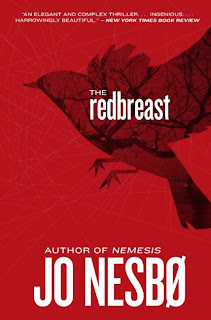
The Redbreast by Jo Nesbø

https://blogger.googleusercontent.com/img/b/R29vZ2xl/AVvXsEjI1IcYYQxQ0z-bnlp_fZRhTzPxkl1LngIzEUubxD_HS0qCZZtDAw20cVIu0asl1DeUoGvPt5iIEkumWbEVnRJlYsJey3zySSz-RPIijC8LJ9Z5ge_-K8C9hdRobTMIuReLm_S8YqXVV5wz/s320/redbreast.jpg

Harry had driven right up to her house before he realised where he was. He stopped the car and stared between the trees. It was fifty or so metres to the house from the main road. There was light in windows on the ground floor.

'Idiot,' he said aloud and started at the sound of his own voice. He was about to drive off when he saw the front door open and light fall on the steps. The thought that she might see and recognise his car put him in a state of panic. He slotted the car into reverse so that he could back quietly and discreetly up the hill and out of sight, but he didn't have his foot hard enough on the accelerator and the engine died. He heard voices. A tall man in a long, dark coat had come out on to the steps. He was talking, but the person he was talking to was hidden by the door. Then he leaned in toward the door opening and Harry could no longer see them.

They're kissing, he thought. I've driven up to Holmenkollen to spy on a woman I've talked to for fifteen minutes kissing her boyfriend.

Then the door closed, and the man got into an Audi and drove past him down to the main road.

On his way home Harry wondered how he should punish himself. It had to be something severe, something that would have a deterrent effect for the future. An aerobics class at Focus.

-The Redbreast

Harry Hole is a great policeman, but when he's assigned to work security during a peace summit in Oslo, he makes a huge, potentially career-ending mistake. He goes on a bender, as is his wont. When he sobers up, he discovers he's been promoted. Bureaucracy.

His new position mostly involves him sitting in a lonely office at the end of the hall, pushing papers - it's a good place for his superiors to keep an eye on him, but it's soul-sapping work for him. And yet, even when he's only left with paperwork, Harry can't help but be a good detective. It isn't long before something catches his eye - a report of someone discovering spent ammunition from a Märklin rifle. It's an unusual weapon - "the ultimate professional murder weapon," in Harry's words. Naturally, he can't help but wonder what someone is planning to do with it.

Someone is planning Very Bad Things. The Redbreast tells both a story in the present, of Harry's pursuit of the Märklin riflesman, and one in the past - in 1944, to be specific, when some Norwegians, then under German occupation, chose to fight for Germany on the Eastern Front. It's a piece of history I was wholly unfamiliar with, and Nesbø does an excellent job weaving together history and fiction, past and present, including a link between the Norwegian defectors and the modern resurgence of neo-Nazism. The plot, as you might imagine, gets a bit complex - and I might even say there's one twist too many toward the end - but it's certainly clever and hugely absorbing. I was reluctant to put it down.

Harry Hole is a wonderful protagonist, another take on the damaged detective. He has little resembling a personal life (and you can see the trouble he gets into when he tries in that excerpt above) and only a tenuous grasp on sobriety. In the middle of the book, he leaves someone a series of absolutely gutting answerphone* messages while he (quite understandly, as it happens) is totally blitzed. But, unlike many of those fictional alcoholic renegade cops out there, Harry goes to the gym. He listens to Joy Division. (If I hadn't been sold on Harry already, that would have done it. I always find it mysterious that so many fictional detectives listen to classical and opera**.) Harry is his own man: a true Gen-Xer, he wears Doc Martens to court. Love.

Honestly, if I could have the next book in the series, Nemesis, in my hands now, it would be there. Alas, I could only find it in hardcover at the bookstore, and I had to be realistic about how I should spend my money. If I see it in paperback before I come home, though...

Up next: the 6th Sookie Stackhouse - the ultimate vacation reading!

*Yes, that was a bit over-the-top British, but gutting is without a doubt the best word for them. And answerphone, besides being the term used in the book, sounds so much better than the unwieldy answering machine, don't you think?

** Wallander, John Rebus, and Inspector Morse, I believe, just off the top of my head.

Sunday, March 21, 2010

Catch-all


I'm heading out of town, and thus have made the promised book switch: Keats is on hold for the time being (though I am enjoying it), and I'm looking forward to settling in with Jo Nesbo's The Redbreast tomorrow. Entertainment Weekly compared series protagonist Harry Hole* to The Wire's Jimmy McNulty in their review of Nesbo's latest book. Naturally, I was sold.

A few links to round out the post:

Manly Slang from the 19th Century - Brilliant. And you've always needed another term for your fist, am I right? (Try "bunch of fives.")

Sporcle Quizzes: Literature - It's a time-waster all right, but, man, is it a good one. Who knows, you might even learn something. (All of the subjects are good, I should add, I just linked to literature in an attempt to stay roughly on topic.)

Review of The Genius in all of Us by David Shenk
(The New York Times) - You guys, we may all still have time to be geniuses if we work reallyreallyreally hard. Of course, I misread the author's name as Shrek, so I may be out of the running. (In my defense, I read William Steig's Shrek to kiddos twice last week. Excellent, excellent book.)

Also, if you're in the mood for a BBC period drama, try He Knew He Was Right, based on the novel by Anthony Trollope. It's available to watch now on Netflix. I enjoyed it because it had several interesting storylines, and the main one is quite different from any other period drama I've seen - a husband grows so jealous that it actually drives him mad. Poor Louis Trevelyan, idiotic as he was. I thought he was quite ably played by Oliver Dimsdale, and I was very sympathetic toward his wife Emily (Laura Fraser) as well. Also stars Stephen Campbell Moore (pictured above with Christina Cole)**, David Tennant***, Bill Nighy, and a bunch of actors that might look familiar from other places (I was pleased to see Barbara Flynn from Cracker, she's aces.)

I'm off for a bit - looking forward to coming back with a Redbreast review!


*Let's all pretend it's pronounced differently in Norwegian, shall we?

** I am really starting to love him. He looks born to play the cad, but so far I've always seen him as the nice guy (well, a bit smarmy in The History Boys, but not bad). He makes a lovely nice guy. (See also: Ashes to Ashes, Bright Young Things)

***Yes, you have cracked the mystery of why I sat down to watch this in the first place.

Monday, March 15, 2010

My Booky Wook by Russell Brand


I'm incredibly sentimental about animals. It's the only opportunity I get to occupy the moral high ground: when I got clean, after chatting with some Krishna conscious devotees, I gave up fish as well. They said if you put death into your body you will emit death, but I'm mostly in it for the high ground. "You're vegetarian?" comes the inquiry. "Yes." Then the inevitable, "Do you eat fish?" This is where they catch a lot of people out: the inquisitor is already at this stage anticipating a "Yes" and loading up with, "Ah, well, you're not a proper vegetarian then are you because fish are incredibly sensitive and some of them write haikus." That's why I have to stifle a smug grin when I reply, "No. No, I don't eat fish because it's cruel to them, the lovely little things." And on particularly smarmy days, "If you put death into your body you emit death." Even as a junkie I stayed true - "I shall have heroin, but I shan't have a hamburger." What a sexy little paradox.

-My Booky Wook

Russell Brand is an excellent subway companion - too good, almost. There was more than one day last week that I was loath to get off at my stop because I didn't want my time with Brand to come to an end.

Of course, I only had him in book format, but that was pretty good as far as those things go. (If I'd traveled with the real Brand, I think we can all assume there's no way I would have made it to work without some kind of rannygazoo* ensuing.) My Booky Wook is an eye-poppingly candid account of Brand's rocky childhood in Essex, his ascent into the world of show business, and his simultaneous descent into full-blown heroin addiction. He also deals with his slightly too, ah, spirited pursuit of ladies, which results in a stint in a New Jersey sex rehab. You can see how one might regret having to close the book every morning.

Russell Brand is one of those people I just knew that I'd like - I mean, just look at that hair. How can you not love him a bit?** He stole the show in the (mediocre, in my opinion) Forgetting Sarah Marshall, but I didn't really feel compelled to read his memoirs until I watched The Big Fat Quiz of the Year (search for 2006, 2007, and 2009 on YouTube if you need a laugh - and have a fair amount of time at your disposal). He's just so clever, so cheeky, and especially such a delightful teammate to Noel "King of the Mods" Fielding. (The Goth Detectives. I rest my case.)

"You just give us 48 hours and we'll get the job done - if we weren't so bloody miserable."

I don't think I have much of anything in common with him - but it doesn't matter, because the man can really tell a story, and My Booky Wook captures his distinctive voice perfectly. It's an affecting memoir, really. He tries to make light of things often, but at a certain point you can't help but go, wait, his father's taking him to a strip club in Southeast Asia? He's cutting himself while someone is calling 911 (well, 999)? Clearly things were not ship shape. He's told at one point, right before choosing to go to rehab, that in six months he will be in jail, a mental institution, or dead. It does not seem like an exaggeration. He did some things that I found horrible (or horrifying), but it is a testament to his charm that I still can't help but like him. He's really a singular man, in the end.

Up next: Working on Keats, as I indicated in the previous post. I imagine it will be slow going, and I may take a break as I'm traveling next week, and I can't bear to lug this 600-page behemoth on a plane.

*A Brand word if I ever heard one. Well, a Wodehouse word really, but Brand really has a flair for language. It means nonsense, incidentally.

**I'm sure tons of people have jerky things to say about his hair - I know not everyone shares the love. Tough for them, I suppose.

Thursday, March 11, 2010

In Medias Res: Keats


So, I've finished My Booky Wook, but I'm not focused enough right now to gather my thoughts. Instead, I thought I'd offer this passage from Andrew Motion's biography of Keats, which I've just started.

It was a world fraught with violence. In the factories and the fields, where the conditions of everyday life were routinely shaped by appalling levels of suffering, the danger of rioting was a constant threat. There was a distinctly 'Sturm und Drang quality' about political life too. 'Think of the Earl of Chatham,' one recent historian has urged, 'collapsing in the House of Lords as he made his last manic and incoherent speech against war with America in 1778, or of Edmund Burke flinging a dagger into the floor of the House of Commons in December 1792 as a symbol of his departure from the Foxite Whigs, and of Charles James Fox bursting into tears as a result.' Think too of the Prime Minister Perceval, assassinated in the House of Commons in 1811, or of the startling statistic that nineteen Members of Parliament committed suicide between 1790 and 1820, and that a further twenty lapsed into insanity, as did their king.

Some people think history is dull. I can't imagine they've read the preceding paragraph.

Sunday, March 7, 2010

Divine by Mistake by P.C. Cast


I covetously ratted through yards and yards of clothes until I finally stumbled upon what must be the Sportswear Armoire. It was filled to bursting with soft leather leggings and tops. All the pants were one style, the same buttery-yellow color, each with its own intricately tooled decorations. I recognized a very Celtic-looking knot woven down the sides of many of them. And I swear I could see more of those gross skulls hidden in the decorative leatherwork. They all had narrow legs, and weird ties that laced up high on the left hip (I guessed they were clueless about zippers in this world). I eyed them askance, hoping I hadn't put on any water weight lately. Deciding on one pair that seemed to have the least skull-like pattern, I started to pull them on, and couldn't help but gasp at the supple smoothness of the leather. They felt as if someone had fastened a baby's butt onto my legs.

-Divine by Mistake

I...kind of don't know where to begin. I mean, check out that excerpt. I think you can see why I'm at a bit of a loss. "Baby's butt?" Really? I could have lived a full and happy life without ever seeing someone compare the softness of a pair of leggings to a child's posterior. Truly.

My reading of Divine by Mistake comes down to a classic case of failing to do one's research. When I skimmed the back of the book prior to reading it, I thought the plot had some potential: A midwestern teacher named Shannon Parker buys a vase at an estate sale that transports her to the land of Partholon. There, she discovers that she is the doppelganger of a high priestess, Rhiannon*. She quickly becomes embroiled in all kinds of craziness, including marriage to a centaur and the looming threat of the nasty, blood-sucking Fomorians. I mean, it's not high art, but it sounded like it could be entertaining.

About 200 pages later (and about 200 pages after I realized I would be alternately grinding my teeth and rolling my eyes throughout the book), I took the time to check out the copyright page and discovered that Luna, the publishing company, is an imprint of Harlequin. That really explained a lot: the jokey writing style (Shannon's oft-rumbling stomach is the height of hilarity, apparently, and Cast revisits it often), the frequent dream sequences, and the continued descriptions of what Shannon is wearing. None of which I enjoyed, obviously.

It also explains why Divine by Mistake enjoys an average rating of 4 1/2 stars on Amazon.com, despite the fact it makes Twilight look like Dostoyevsky. I hope it's apparent that I'm not trying to bash P.C. Cast. Clearly her work is quite popular among some readers. If you can tolerate Shannon sizing up a female centaur's "girlfriend potential," making multiple references to John Wayne movies, and navigating romance with her centaurian** intended (the noble yet boring ClanFintan) armed with a slew of hackneyed double entendres involving riding, then I suppose you might enjoy it. It's not my cup of tea, obviously. More like a cup of tea brewed with cilantro, my archnemesis among herbs. Honestly, I didn't even like the font (The curve of the f was so long that when it appeared next to another tall letter, like an l, it looked as though there were almost an entire space between the two letters. Very distracting.) Oh yes, it's nitpicking, I know, but you know things are bad when I can't even wholeheartedly get behind the typeface.

Up next: I love, love, love all things British, in case that was ever unclear, and I particularly love British comedy. I've found that if you "discover" one comedian/show, the British comedy world is small enough that it will inevitably lead you to something else, and eventually you will exhaust the limits of what is on American DVD. This is how I've ended up watching multiple editions of The Big Fat Quiz of the Year on YouTube, and how I came to be entertained by the mischievous and ever-charming Russell Brand. Thus, I snatched up his autobiography, My Booky Wook, from the library yesterday, and I'm pleased to report that so far it is excellent.


*Incidentally, one thing this book did teach me is that I knew the Fleetwood Mac song "Rhiannon." I was aware that a song by that name existed, but it wasn't until I started reading that I matched it up with a song that had started to get stuck in my head with increasing regularity. I'm pretty sure it was on the mix when I worked retail, which was unfortunately skewed toward 70's pop and easy listening.

**Don't worry, they throw some magic at whole situation so there's no bestiality, thank god.