Showing posts with label in translation. Show all posts

Sunday, February 26, 2012

The Snowman by Jo Nesbø


The snow in the yard reflected enough light for him to make out the snowman down below. It looked alone. Someone should have given it a cap and scarf. And maybe a broomstick to hold. At that moment the moon slid from behind a cloud. The black row of teeth came into view. And the eyes. Jonas automatically sucked in his breath and recoiled two steps. The pebble-eyes were gleaming. And they were not staring into the house. They were looking up. Up here. Jonas drew the curtains and crept back into bed.

-The Snowman 

I was so excited to read the next Harry Hole novel--until I realized it wasn't the next Harry Hole novel. I was still happy to read The Snowman, to be sure, but it did take a little bit of the shine off when I realized that somehow The Redeemer had been lost in the shuffle. I'm still not sure why The Redeemer is so unavailable, but I'll get a hold of it somehow--when I'm in London this summer, if nothing else, though it might be hard to wait until then!

Leaving the mysterious publication order aside, The Snowman was another satisfying outing from Jo Nesbø. This time around, Harry's extensive knowledge of serial killers is put to good use when he finds himself on the trail of a criminal who kills women--all mothers--who have cheated on their husbands. The killer is as cold as his icy moniker would suggest, and the crimes are bloodier and more disturbing than I recall from previous Harry Hole stories. Unsurprisingly, the denouement is mind-boggling. I find it quite curious that this is the first Harry Hole story slated to be adapted for film--by Martin Scorsese, no less-- as I simply cannot imagine actually seeing the end of the story on screen. That's not to say it wasn't gripping--it absolutely was--but it also got pretty ludicrous.

Obviously, I'm on board for more Harry Hole books. I was quite keen to keep reading at the end of The Snowman, particularly seeing how badly Harry had been shaken by this case. I'll have to be in suspense a bit longer, though, I suppose, since I do want to read The Redeemer before moving on.

Up next: I was hungry for more mystery, so I went with Laura Lippman's The Most Dangerous Thing.

Thursday, December 30, 2010

The Pyramid by Henning Mankell


In the beginning, everything was just a fog.

Or perhaps it was like a thick-flowing sea where all was white and silent. The landscape of death. It was also the first thought that came to Kurt Wallander as he slowly began rising back to the surface. That he was already dead. He had reached twenty-one years of age, no more. A young policeman, barely an adult. And then a stranger had rushed up to him with a knife and he had not had time to throw himself out of harm's way.

Afterward there was only the white fog. And the silence. 

-The Pyramid 

When readers first met Kurt Wallander in Faceless Killers, he was already middle-aged and divorced, well on his way to becoming the sad sack that we know and love. Glimpses of his past have always been interesting, but few and far between. With The Pyramid, a collection of short stories by Henning Mankell, we finally get a better look at how Wallander became the detective and the man that he is.

In the first story, which I excerpted above, Wallander is still a beat cop in the very early stages of honing his instincts when he stumbles upon his first homicide investigation. By the last, he's within a month of embarking upon the Faceless Killers case. Needless to say, there's a lot that goes on in the meantime. As a pretty big fan of the series, I found it utterly absorbing to watch the way he grew, both as a person and as a detective. He makes mistakes--big mistakes, potentially fatal mistakes--and both learns and doesn't learn from them. I think that by reading these stories, I really began to appreciate the continuity in Mankell's work. Both Wallander's flaws and strengths were apparent pretty early on, and it's neat to see the way Mankell returns to and builds upon them, especially given what we already know of Wallander from the novels. I am more eager than ever to read the novels that I've missed so far.

I particularly found the evolution of Wallander's relationship with his father fascinating. In seeing the progression of his father's dementia from Wallander's point of view, we share his anger and frustration, but also his fears. This is captured especially well in the title story, in which Wallander's father fulfills the dream of a lifetime in going to Egypt, which has unexpected ramifications in Wallander's life as well as in the development of his case. I think I will be more tuned in to their relationship as I continue to read the series based on what I now know of their history. 

Interestingly, despite the fact that the events in this book proceed all other Wallander stories chronologically, I think it is best enjoyed after having at least one of the novels. This is not meant to be an introduction to the character; it's more of a reflection, with themes that will most resonate with readers who are already familiar with the series. I do think Mankell perhaps went a little heavy on emphasizing the Swedish anxiety theme--which he also makes a note about in the forward--but I can't actually disagree with him as to its importance to the character and the series. I could have probably done with one fewer pointed aside from Wallander or another character on the subject, though. That having been said, I enjoyed this book thoroughly and accordingly raced through it pretty darn fast. I have a lot of books in the lineup now, but surely another Wallander book will have to pop up in the near future.

Up next: Finally tracked down Dracula, which has been an interesting reread so far.

Sunday, August 1, 2010

The Devil's Star by Jo Nesbø


She half turned without seeing him and wrinkled her nose as if there was a potent smell coming from somewhere, which was a possibility Harry could not completely exclude. She asked the checkout girl for a pack of 20 Prince Mild cigarettes.

'Thought you were trying to give them up.'

Vibeke turned round in surprise, scrutinised him and gave him three different smiles. The first one, fleeting, automatic. Then one of recognition. Then, after she had paid, one of curiosity.

'And you're going to have a party, I see.'

She put her purchases into a plastic bag.

'Something like that,' Harry mumbled, reciprocating her smile.

-The Devil's Star

Harry Hole is in a bad way. As we saw in The Redbreast and Nemesis, Harry's struggle with his demons is unending. By the beginning of The Devil's Star, Harry has given up the fight.

We don't know why at first, but the result couldn't be clearer: we meet Harry in the midst of an epic bender. His supervisor kindly put him on leave four weeks earlier, when Harry just stopped showing up for work. But a police officer can't be on leave indefinitely, and he's finally called in to a crime scene. A woman has been murdered; her index finger ritualistically severed. Harry's partnered up with Tom Waaler, whom he loathes. It comes as no surprise that things get off to a rocky start.

'One of the officers at the crime scene threatened to write a report on you. He says you were visibly intoxicated when you arrived [...] Were you intoxicated, Harry?'

'Of course I wasn't, boss.'

'Are you absolutely positive you're telling me the truth right now, Harry?'

'Are you absolutely positive that you want to know?'

Harry heard Møller's groan at the other end.

Soon enough, a woman has disappeared, and it isn't long before the two cases are connected. As usual, Nesbø has engineered a remarkably clever mystery that requires a serious amount of effort to untangle. The Devil's Star is complex without becoming overly convoluted; Nesbø seems to have become somewhat more judicious with his twists. (I did have a bit of trouble picturing some of the logistics of the gruesome climax. Perhaps that was just a self-preservation instinct.) Overall, I consider it the strongest of Nesbø's novels to date.

Aside from his crackerjack plots, Nesbø's greatest strength as an author is the shape he gives to the damaged, driven Harry*. There is no romanticizing of Harry's problems here—Nesbø never shies away from showing exactly how low Harry can fall. I was wincing at points, because at his core Harry is wonderful—smart, resourceful, caring, funny—and as a reader I can't help but hope for better for him. Harry's behavior, in this book more than any other, has realistic and potentially far-reaching consequences. I am very interested to see where things lie at the start of the next book, The Redeemer. I'm not sure when it will be out in the US, but I see that it's already available in paperback from amazon.co.uk. Oh, so tempting....

Up next: I'm picking up The Botany of Desire again. Good so far, but I can't exactly call it a page-turner.

*And all of his characters, really. I'm consistently impressed to how much depth he gives to characters who might only be around for a few pages.

Saturday, June 26, 2010

The Man from Beijing by Henning Mankell

The sky seemed close; the stars shone brightly that night. I can see the surface, she thought. There is a connection, thin threads intertwining with one another. But what lay behind it all? What was the motive for killing nineteen people in the north of Sweden, and also putting an end to a family in the Nevada desert? Probably no more than the usual: revenge, greed, jealousy. But what injustice could require such drastic revenge? Who could gain financially by murdering a number of pensioners in a northern hamlet who were already well on their way to death? Who could possibly be jealous of them?

-The Man from Beijing

Whew. I started The Man from Beijing quite awhile ago and, under normal circumstances, I would have finished awhile ago as well. However, I broke my leg two weeks ago, and in the early days of my recovery, I found the novel didn't suit my mood at all. I almost put it down entirely, as I was in the middle of a grim and seemingly interminable flashback section. But I persevered, and here we are.

In The Man from Beijing, Henning Mankell grabs the reader with an intriguing (if grisly) premise: 19 savage murders, killing almost the entire population of a little Swedish village in one fell swoop. We're drawn into the police investigation, but our true protagonist emerges a bit later. Her name is Birgitta Roslin, and she's a judge with no professional connection to the case. She discovers, though, that she has a personal one, and before she knows it, Birgitta has developed her own independent line of inquiry.

The police are dismissive, but Birgitta keeps investigating, ensnaring herself in a situation that is far more dangerous that she could have imagined. The story she eventually pieces together spans four continents and relies on events that transpired more than 150 years ago. Despite this, I wouldn't call The Man from Beijing overly complicated, though Mankell does get bogged down in history at some points. Nevertheless, by the end of the novel he kicks things into high gear in a manner that should leave fans of suspense happy.

Overall, I didn't find The Man from Beijing quite as absorbing as I would have hoped. I found Birgitta to be a likable protagonist, and I appreciated that she was an amateur detective, which is fairly unusual in mysteries nowadays. I was less interested, though, when Mankell veered away from her story and delved into geopolitical concerns. My disinterest might have also stemmed from my mood, of course, as I really wanted something much lighter in tone* (Sookie Stackhouse, where art thou?). Still, I think international thrillers just aren't my cup of tea. I'd be much more excited to read another of Mankell's Wallander stories as opposed to another stand-alone novel.

Up next: Commencement by J. Courtney Sullivan

*I've been simultaneously rereading Naked by David Sedaris, which was really the type of book I needed. I find that Sedaris is pretty much indispensable during any trying times.

Saturday, May 29, 2010

Nemesis by Jo Nesbø


Harry rubbed the palm of his hand over his unshaven chin, reflecting on what Aune had said about drugs simply emphasising latent tendencies. He didn't know if he found that reassuring. Isolated details were beginning to emerge. A black dress. Anna had been wearing a black dress. And he was lying on the stairs. A woman helped him up. With half a face. Like one of Anna's portraits.

'I always have blackouts,' Harry said. 'This is no worse than any of the others.'

'And your eye?'

'Probably bumped into a kitchen cupboard when I came home or some such thing.'

'I don't want to worry you, Harry, but it looks like something more serious than a kitchen cupboard.'

'Well,' Harry said, taking the cup of coffee with both hands. 'Do I look bothered?'

-Nemesis

Inspector Harry Hole has had a lousy night, as you might have guessed from the passage above. The semi-recovering alcoholic made the questionable choice of having dinner with a former flame and woke up the next morning with a splitting headache and no memory of the previous evening. The day is not off to a promising start, and things get worse when a call comes in: a woman found dead in her flat, an apparent suicide. Harry isn't so sure. The woman is Anna, his date from the night before.

In Nemesis, poor Harry already had his hands pretty full before this most recent development. His girlfriend's in Moscow, locked in a bitter custody dispute with her ex-husband. He's working a tough case, that of a robber, nicknamed The Expeditor, who killed a bank teller in the course of a heist. And he's still doggedly pursuing any wisp of a lead he uncovers in the case of a fellow officer's murder. On top of all of this, he gets an e-mail.

Shall we play? Let's imagine you've been to dinner with a woman and the next day she's found dead. What do you do?

What does Harry do? He doesn't tell his girlfriend, for one. Nor does he inform the police of his ties to Anna. Instead he puts his head down and gets to work, using every connection he has in order to try to tease out answers in his cases, both of which are becoming increasingly complicated. His investigation takes him everywhere from gypsy caravans in Oslo to the criminal underground in Brazil. Did I mention it gets complicated?

Jo Nesbø excels in telling smart, twisty tales, and Nemesis is just as satisfying as The Redbreast, its predecessor in the Harry Hole series. Harry's a very compelling character and, in addition to his new travails, Nesbø has also set up an intriguing ongoing case with the investigation of the murdered officer. I hesitate to say too much about that aspect of the book, since it was a pivotal plot point in The Redbreast, and I think surprise is an important element in this series. As readers, we know more than Harry about the officer's death and the related corruption in the police department; I cannot wait to see what happens when he puts it all together. He'll either wreak vengeance or utterly collapse - and possibly both. You can see why it's going to be difficult to resist the siren call of The Devil's Star, the third book in the series, currently only available in hardcover (it was released in March). Let's hope that the library hold list is moving at a brisk pace, shall we?

Up next: Thanks to my pal Robin, I do have the next two books in another enjoyable (although entirely different) series, Charlaine Harris's Sookie Stackhouse books. I'm already digging in to All Together Dead.

Saturday, March 27, 2010

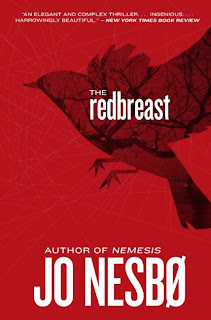
The Redbreast by Jo Nesbø

https://blogger.googleusercontent.com/img/b/R29vZ2xl/AVvXsEjI1IcYYQxQ0z-bnlp_fZRhTzPxkl1LngIzEUubxD_HS0qCZZtDAw20cVIu0asl1DeUoGvPt5iIEkumWbEVnRJlYsJey3zySSz-RPIijC8LJ9Z5ge_-K8C9hdRobTMIuReLm_S8YqXVV5wz/s320/redbreast.jpg

Harry had driven right up to her house before he realised where he was. He stopped the car and stared between the trees. It was fifty or so metres to the house from the main road. There was light in windows on the ground floor.

'Idiot,' he said aloud and started at the sound of his own voice. He was about to drive off when he saw the front door open and light fall on the steps. The thought that she might see and recognise his car put him in a state of panic. He slotted the car into reverse so that he could back quietly and discreetly up the hill and out of sight, but he didn't have his foot hard enough on the accelerator and the engine died. He heard voices. A tall man in a long, dark coat had come out on to the steps. He was talking, but the person he was talking to was hidden by the door. Then he leaned in toward the door opening and Harry could no longer see them.

They're kissing, he thought. I've driven up to Holmenkollen to spy on a woman I've talked to for fifteen minutes kissing her boyfriend.

Then the door closed, and the man got into an Audi and drove past him down to the main road.

On his way home Harry wondered how he should punish himself. It had to be something severe, something that would have a deterrent effect for the future. An aerobics class at Focus.

-The Redbreast

Harry Hole is a great policeman, but when he's assigned to work security during a peace summit in Oslo, he makes a huge, potentially career-ending mistake. He goes on a bender, as is his wont. When he sobers up, he discovers he's been promoted. Bureaucracy.

His new position mostly involves him sitting in a lonely office at the end of the hall, pushing papers - it's a good place for his superiors to keep an eye on him, but it's soul-sapping work for him. And yet, even when he's only left with paperwork, Harry can't help but be a good detective. It isn't long before something catches his eye - a report of someone discovering spent ammunition from a Märklin rifle. It's an unusual weapon - "the ultimate professional murder weapon," in Harry's words. Naturally, he can't help but wonder what someone is planning to do with it.

Someone is planning Very Bad Things. The Redbreast tells both a story in the present, of Harry's pursuit of the Märklin riflesman, and one in the past - in 1944, to be specific, when some Norwegians, then under German occupation, chose to fight for Germany on the Eastern Front. It's a piece of history I was wholly unfamiliar with, and Nesbø does an excellent job weaving together history and fiction, past and present, including a link between the Norwegian defectors and the modern resurgence of neo-Nazism. The plot, as you might imagine, gets a bit complex - and I might even say there's one twist too many toward the end - but it's certainly clever and hugely absorbing. I was reluctant to put it down.

Harry Hole is a wonderful protagonist, another take on the damaged detective. He has little resembling a personal life (and you can see the trouble he gets into when he tries in that excerpt above) and only a tenuous grasp on sobriety. In the middle of the book, he leaves someone a series of absolutely gutting answerphone* messages while he (quite understandly, as it happens) is totally blitzed. But, unlike many of those fictional alcoholic renegade cops out there, Harry goes to the gym. He listens to Joy Division. (If I hadn't been sold on Harry already, that would have done it. I always find it mysterious that so many fictional detectives listen to classical and opera**.) Harry is his own man: a true Gen-Xer, he wears Doc Martens to court. Love.

Honestly, if I could have the next book in the series, Nemesis, in my hands now, it would be there. Alas, I could only find it in hardcover at the bookstore, and I had to be realistic about how I should spend my money. If I see it in paperback before I come home, though...

Up next: the 6th Sookie Stackhouse - the ultimate vacation reading!

*Yes, that was a bit over-the-top British, but gutting is without a doubt the best word for them. And answerphone, besides being the term used in the book, sounds so much better than the unwieldy answering machine, don't you think?

** Wallander, John Rebus, and Inspector Morse, I believe, just off the top of my head.

Saturday, January 30, 2010

Faceless Killers by Henning Mankell


He could feel his stomach churning. I'm repressing things, he thought. Along with everything else I don't have time for. I'm searching for the slayers of the dead and can't even manage to pay attention to the living. For a dizzying instant his entire consciousness was filled with only one urge. To take off. Flee. Disappear. Start a new life.

He stepped onto the little dais and welcomed his audience to the press conference.

-Faceless Killers

An elderly farmer wakes up in the middle of the night, struck by the sense that something is wrong. Gradually, he hears the faint cries from his neighbor's home. He walks into the horrific aftermath of violence - a man dead, his wife hanging on by a thread. She makes it to the hospital, where she utters her last word: "Foreign."

Inspector Kurt Wallander is lead on the case, in the absence of his superior officer, Björk, who is on holiday. It's a devil of a case, with virtually no leads besides the woman's last word, the meaning of which makes Wallander uneasy - there has already been local trouble with the refugee camps, and he hesitates to pursue a course of action that could stir up more unrest. Meanwhile, he struggles with a host of personal issues: his recent divorce, his terrible diet, his father's deteriorating mental state, and the distant relationship he has with his daughter.

Interestingly, despite these issues, Wallander is not quite as morose as I found him to be in the later stories I've read. Instead, he's angrier. The one time he gets teary, he notes that he can't remember the last time he's cried (which, boy howdy, simply cannot be the case in the later books unless he has a truly lousy memory). It made me feel a bit worse for him, honestly, to see that he has become so miserable - of course, I think he, like a lot of characters (paging Dr. House), would not be nearly so interesting were he content.

I'm now even more excited to read the intervening books, and see exactly how events shaped Wallander into the detective he has been in more recent years. I am going to have to start tracking down the original Swedish sequence of books (they weren't released in order here) and putting things on hold at the library.

Up next: I've started reading Animal, Vegetable, Miracle by Barbara Kingsolver. While it's obviously not as engrossing as a mystery, I'm enjoying it so far. I also checked out a real grab-bag of books at the library, but I'll save those for another day.

Sunday, December 20, 2009

One Step Behind by Henning Mankell


Wallander stopped in his tracks on the narrow footpath. In his mind he went back to the moment when he had stood in the doorway of the living room and first witnessed the devastation. Martinsson had been right behind him. He had seen a dead man and a shotgun. But almost at once he was struck by the feeling that something wasn't quite right. Could he make out what it was? He tried again without success.

Patience, he thought. I'm tired. It's been a long night and it's not over yet.

He started walking again, wondering when he would have time to sleep and think about his diet. Then he stopped again. A question suddenly came to him.

What if I die as suddenly as Svedberg? Who will miss me? What will people say? That I was a good policeman? But who will miss me as a person? Ann-Britt? Maybe even Martinsson?

A pigeon flew by close to his head. We don't know anything about each other, he thought. What did I really think of Svedberg? Do I actually miss him? Can you miss a person you didn't know?

-One Step Behind

Poor Wallander. At the start of One Step Behind, he's battling constant fatigue; he goes to the doctor only to be diagnosed as diabetic. He's ashamed by this diagnosis, disgusted by his own bad habits. He vows to make a change, only to have his plans for healthy living derailed by his discovery of a colleague's murder. Suddenly he's heading up the investigation, fantasizing about those little clumps of sugar floating in his blood and struggling to keep moving forward despite his ever-deteriorating health and subsequent gloominess. Of course, this is Wallander - gloominess seems to suit him.

Wallander realizes that his colleague's murder is tied to the disappearance of three young people, and from there things get complex. Mankell invents quite the intricate tale of murder and mayhem, and I enjoyed seeing Wallander having to suss the tiniest of details as he doggedly pursues answers in a case that presents question upon question. I think this story worked even better as a book rather than in televised form, and not only for the usual reason that the book presents a more detailed story. The plot of One Step Behind hinges on an important photograph, and I think things are much more mysterious if one can't actually see this photograph - otherwise it's much easier to solve the mystery, which in turn makes Wallander & co. look a bit thick.

Although One Step Behind was less ambitious in scope than the globe-spanning adventures of The White Lioness, I enjoyed it just as much. I am quite looking forward to reading more Wallander mysteries - not too much more to say as I hesitate to spoil any more of a mystery's plot than I have to. Also, I'm on my second day of winter break and I feel a bit too scattered to write up anything properly. Apologies for the brief and less-than-elegant post.

Up next: Flannery, by Brad Gooch, a biography of one of my hands-down favorite writers, Flannery O'Connor.

Saturday, July 4, 2009

Blackwater by Kerstin Ekman


"Shh!" said Mia. She was listening intently. Then Annie could hear a sharp, regular sound and a thumping. It was coming closer, and she realized someone was moving along the path farther up and coming toward them. She put her arm around Mia and almost pushed her down behind the tree trunk. The girl landed on the map, which rustled. Then Annie heard the noise again and realized the sharp sound was someone breathing. Panting. But she couldn't make out whether it was an animal or a human being. She held Mia pressed to the ground, but the tree trunk wasn't high enough to conceal Annie, too.


He never even saw her. He was lumbering up the slope, looking straight ahead, his mouth open, his sharp breathing coming in small labored gasps. He was very dark, with long, dead-straight hair he had tucked behind his ears. His eyes were narrow and black and he was carrying something in his arms. She had no time to identify it, seeing only that it hindered him as he hurried on. Then he was gone.


-Blackwater

It is this chance sighting in the forest, in the dead of night, that Annie Raft thinks back to at the beginning of the novel Blackwater. She's convinced she's just seen the same mysterious figure some 18 years later, this person whom she saw only a short while before stumbling upon a gruesome double murder scene. Clearly the two events must be related - right?

One quickly discovers that Kerstin Ekman is interested in probing the mistakes people make and misconceptions they have, and how they can have profound effects. Ekman has a talent for creating complex, flawed characters that don't fit into neat boxes; she is also an able wordsmith (evident even in translation from the original Swedish). Despite these assests, Blackwater is still a rather unsatisfying read.

I've learned that one of the easiest ways a work of art (be it novel, film, etc.) can disappoint you is to unhappily defy your expectations. If you go in expecting a funny book and find things to be quite grim instead, for example. Perhaps it's a wonderfully written serious book, but if you started in expecting to laugh, it may be hard to fully appreciate it.

I expected Blackwater to be a mystery. I suppose it is, in a way (and I've tagged it as such), but it became evident to me that Ekman was far more interested in exploring the ramifications of that double murder on a few of the local residents than actually following the investigation of the crime (really, that only dominates the story in about the last 50 pages or so, and the resolution is fairly anticlimactic). Not a bad idea at all, but not what I'd hoped to read. The rest of the book deals with life on a Swedish commune (not necessarily my cup of tea, as it turns out), the sexual initiation of a teenage boy living with an older woman (Ekman gets almost romance-novel smutty here, and elsewhere, actually), and the dissolution of a doctor's marriage (actually the easiest part to relate to). The novel's protagonist, Annie, is, frankly, rather strange, and I can't say I ever really understood her. It's an interesting choice that puts things a bit off-kilter, but I can't say it actually made the story more enjoyable.

So not much more to say about that one. I've begun Dead Until Dark, the first Sookie Stackhouse novel (on which the show True Blood is based, not that I've seen it yet). I'm hoping it's a good one, since reading two fairly mediocre books in a row is a pretty bad run, to me.

Wednesday, June 17, 2009

The White Lioness by Henning Mankell


He sat down on a rock, even though it was damp. All of a sudden his weariness and depression threatened to overwhelm him. With a sigh even he thought was pathetic, he decided he was as much at sea with his own life as he was with the search for Louise Akerblom's murderer.

Where do I go from here? he said to himself. I don't want anything to do with ruthless killers, with no respect for life. I don't want to get involved in a kind of violence that will be incomprehensible to me as long as I live. Maybe the next generation of policemen in this country will have a different kind of experience and have a different view of their work. But it's too late for me. I'll never be any different from what I am, a pretty good policeman in a medium-sized Swedish police district.


-The White Lioness

Those are the thoughts of Chief Inspector Kurt Wallander, a detective operating out of Ystad, Sweden. At that point in The White Lioness, poor Wallander has no idea how involved he will become in the ruthless violence of the story's villains, making decisions that cause him to even question his status as a "pretty good" cop.

It all starts as a missing persons case. Right away, just in his reaction to those circumstances, I realized that Wallander was a different sort of cop. He's not jaded, for one, not one of those world-weary policemen with a chip on his shoulder who's too smart for his own good. He's sick with worry over the case, especially because he has a hunch that it's not just a missing persons case - he has a gut feeling that it's murder. And he really, really doesn't want it to be.

Perhaps it's because he's Swedish, or perhaps it's just his personality, but Wallander is a remarkably human, relatable detective. He's not a genius, but he works hard and cares a lot - perhaps too much, for a cop. His work overwhelms his life, and he's crushed by the unrelenting strain of pushing through one terrible event after another. He cries a lot.

Not that I blame him, and that's part of the reason that I love him as a character. If I were handling a missing persons case turned murder investigation, which went on to have ties to ex-KGB agents and a South African hitman, I would be pretty upset as well. Wallander is a provincial cop, and he's really not equipped to deal with all of that. He does the best he can, which involves making quite a few mistakes. I found the novel all the more compelling for it.

The novel also goes for long stretches that don't involve Wallander at all, and focus more on characters navigating the political unrest of early 1990s South Africa. I found this part interesting as well - I studied that period in one of my favorite college courses - although I did miss Wallander during first extended passage set outside of Sweden. Mankell does an excellent job tying it all together, and I really was unsure how the good guys would be able to save the day.

I am absolutely looking forward to more Wallander books. I would definitely recommend them to mystery fans - although I know some people are not wild about sad sack characters, in which case you might want to steer clear. And as I mentioned in an earlier post, the BBC/Masterpiece Theatre Wallander series is also worth checking out - it definitely helped me to picture the Swedish seaside (which looks absolutely lovely). I myself am part Swedish, though I know next to nothing about the culture, so I appreciate Wallander for that reason as well.

Up next: I have quite a bevy of books to choose from at this point, but I think I'll go back to the YA well and try The Mysterious Benedict Society.